

An air-pressure wine opener removes a cork in seconds without twisting or pulling. The mechanism is simple. This guide explains exactly how it works, what happens inside the bottle, and why it is so much easier than a traditional corkscrew.
Most people have struggled with a corkscrew at some point. The worm slips. The cork breaks. A chunk of cork falls into the wine. An air pressure wine opener solves all of that with a completely different approach. Instead of pulling a cork out from above, it pushes the cork out from below using air. The result is faster, cleaner, and far less effort. This guide explains the full mechanism in plain language.
01
The Basic Idea Behind Air Pressure Opening
A cork stays in a wine bottle because of friction. The cork is slightly wider than the bottle neck. When pushed in, it compresses and grips the glass walls tightly. That grip is what keeps the wine sealed and the cork in place.

A traditional corkscrew overcomes that grip by screwing into the cork from above and pulling it upward. An air pressure opener takes a completely different approach. It adds air pressure below the cork. When the pressure inside the bottle becomes strong enough, it overcomes the friction holding the cork and pushes it out smoothly from underneath.
No twisting. No pulling. No physical strain. Just air is doing the work.
02
The Three Parts That Make It Work
Every air pressure wine opener has three functional parts. Each part plays a specific role in the process. Understanding each one makes the whole mechanism easy to follow.
- Made from thin stainless steel
- Has a hollow channel running through the center
- Pierces through the cork from top to bottom
- Creates the path for air to enter the bottle
- Leaves only a small hole in the cork
- Sits above the needle on the opener body
- Pushed down repeatedly by hand
- Forces air through the needle with each pump
- Requires very little physical strength
- No twisting or wrist rotation needed
- Connects the pump handle to the needle
- Acts as a small air channel between both
- Holds the needle steady on the bottle
- Available in pen-shaped and traditional grip styles
- No batteries or electric components
- Cork seals the bottle by friction against the neck
- Air builds up in the sealed space below the cork
- Pressure increases with each pump of the handle
- When pressure exceeds friction, the cork rises
- Cork exits cleanly with an audible pop
03
The Physics of Cork Removal
The science behind an air pressure opener is straightforward. You do not need to understand physics to use one, but knowing what is happening inside the bottle helps explain why it works so reliably.
When you push the needle through the cork and begin pumping, you are forcing air into a sealed space. The bottle below the cork is already full of wine and a small amount of air. Each pump adds more air molecules into that space. More molecules in the same space means higher pressure. That pressure pushes outward in all directions equally, including upward against the bottom of the cork.
A cork held in a bottle by friction requires a specific amount of force to release it. A traditional corkscrew applies that force from above, pulling the cork against the friction. An air-pressure opener applies that force from below, pushing the cork along. Pushing with pressure is smoother and more controlled than pulling against resistance. That is why the cork exits slowly and cleanly rather than popping suddenly.
What happens inside the bottle as you pump
- Each pump stroke pushes a small amount of air through the needle
- The air enters the bottle below the bottom of the cork
- Pressure builds with each additional pump stroke
- The cork begins to shift upward as pressure rises
- Once the pressure overcomes the friction holding the cork, it exits
- The exit is controlled and gradual, not a sudden explosion
04
How to Use One Step by Step
Using an air-pressure wine opener takes less than 10 seconds once you have done it. The process is the same regardless of the brand or style of opener you have.
- Remove the foil cap from the top of the bottle to expose the cork.
- Hold the bottle steady on a flat surface or grip the base with one hand.
- Place the tip of the needle directly in the center of the cork top.
- Push the needle straight down through the cork until the guard rests on the top of the cork. The needle should pass all the way through to the other side.
- Begin pumping the handle slowly and steadily. Each press forces air through the needle into the bottle.
- Continue pumping and watch the cork. It will begin to rise slowly from the neck after four to six pumps.
- The cork will exit fully on its own or after a final light pump. Hold the bottle still as the cork comes out.
- Slide the cork off the needle. It is intact and can be reused to reseal the bottle.
05
How Many Pumps Does It Take?
The number of pumps varies slightly from bottle to bottle. Most corks come out after four to eight pumps. A few factors influence how many you will need in practice.
| Cork Condition | Typical Pumps Needed | Notes |
|---|---|---|
| Fresh, snug cork | 5 to 7 pumps | Standard for most new bottles |
| Slightly older or softer cork | 4 to 6 pumps | Less friction means less pressure needed |
| Long-aged wine cork | 6 to 9 pumps | Drier cork grips more tightly |
| Synthetic cork | 5 to 8 pumps | Works the same way as natural cork |
The opener will tell you when the cork is ready. You will feel the resistance change as the cork starts to rise. Stop pumping once the cork exits. There is no need to keep adding air once the seal is broken.
06
Air Pressure vs a Traditional Corkscrew
Both tools open a wine bottle, but they work in opposite ways. Understanding the difference helps explain why an air pressure opener is easier for most people, especially those who open wine regularly or have difficulty with grip strength.
| Feature | Air Pressure Opener | Traditional Corkscrew |
|---|---|---|
| Method | Pushes the cork from below using air | Pulls the cork from above using force |
| Physical effort | Very low, no grip strength needed | Moderate to high, requires wrist rotation |
| Cork condition after | Intact, small needle hole only | Shredded, with a hole through the center |
| Risk of breaking cork | Very low | Moderate, higher on older corks |
| Speed | 5 to 10 seconds | 15 to 30 seconds with skill |
| Works without power | Yes, fully manual | Yes, fully manual |
| Works on sparkling wine | No, never use on sparkling wine | No, sparkling wine is cage-sealed |
07
Why the Cork Comes Out Intact
One of the most useful features of an air-pressure opener is that the cork comes out in one piece. With a traditional corkscrew, the worm bores a spiral hole through the center of the cork. That hole weakens the cork. On older or drier corks, it often causes pieces to break off and fall into the wine.
An air pressure opener does not bore into the cork at all. The needle is hollow and thin. It passes through the cork cleanly without removing any material. The cork itself is not drilled or broken. It simply slides out of the bottle neck, pushed by the pressure from below.
What the needle does and does not do
- The needle pierces the cork but does not remove the cork material
- The hole left by the needle is small and does not weaken the cork structurally
- The cork walls stay intact, so the cork can still seal the bottle
- After removal, the cork can be pushed back into the bottle to reseal it
- No cork fragments fall into the wine at any point in the process
08
When Not to Use an Air Pressure Opener
An air pressure wine opener works reliably on still wine bottles sealed with natural or synthetic cork. There are a few situations where it should not be used at all.
Other situations to be aware of
- Bottles sealed with a screw cap cannot be opened with this tool
- Bottles sealed with a glass stopper do not work with a needle opener
- Very old and severely deteriorated corks may compress around the needle rather than stay firm enough to be pushed out
- Bottles with extremely tight corks may take more pumps than expected, but will still open
- If the needle is bent or damaged, replace it before use
09
The Right Opener to Have at Home
If you regularly open wine at home, an air-pressure opener is one of the most practical tools to keep in a kitchen drawer. It works on almost every still wine bottle, requires no special technique to learn, and takes up very little space.
The most popular style for home use is a pen-shaped air pressure opener. It is compact, lightweight, and easy to store. It works just as well as a larger pump-style opener and is much easier to keep in a drawer or carry to a gathering. The Novaireluxe pen-shaped air-pressure wine opener is a compact, safe, and affordable option that works with any still wine bottle. For a full comparison of opener types and what to look for before buying, read our complete guide on air pressure wine openers and the smart way to open any bottle.
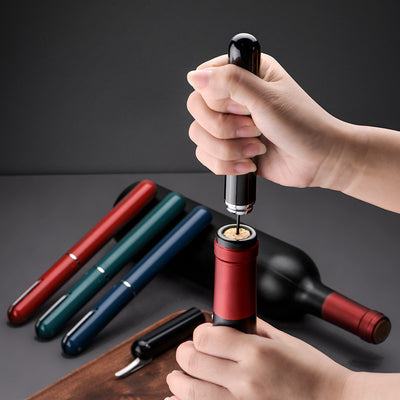
Pen-Shaped Air Pressure Wine Bottle Opener
Opens any still wine bottle in seconds without twisting or pulling. Compact ABS body, safe needle design, and easy to use for anyone. Cork exits fully intact every time. Perfect for home use, bars, and gifting.
From €16,14 Shop NowWhat to look for when choosing one
- A stainless steel needle that is straight and sharp
- A comfortable grip on the pump handle
- A needle guard that rests flat on the bottle rim
- Compact enough to store in a kitchen drawer
- Food-safe materials throughout
- Comes with at least one replacement needle
FAQ
Questions People Also Ask
Simple Physics. Effortless Opening.
An air-pressure wine opener uses a single straightforward principle. Air pushed into a sealed bottle builds pressure below the cork. That pressure overcomes friction, and the cork slides out intact. No twisting. No pulling. No broken corks. Just a needle, a few pumps, and a bottle opened in seconds.
Get the Opener from €16,14