

Cork breakage is almost never bad luck. It has specific causes, predictable patterns, and a clear solution. This guide explains exactly why corks break, what to do when one does, and how to make sure it never happens again.
A few moments in a wine evening go wrong as visibly as a breaking cork. The top half comes away on the corkscrew. The bottom half stays lodged in the neck. Fragments fall into the bottle. The frustration is immediate, and the cause seems mysterious. It rarely is.
Cork breakage is almost always traceable to one or more specific, identifiable causes: a dry cork that lost its elasticity, a corkscrew worm inserted at the wrong angle, insufficient insertion depth, or extraction pulled too quickly and unevenly. Understanding each cause makes you a better host and a more confident opener. More importantly, it leads to the one tool that entirely removes the risk of cork breakage.
01
What a Cork Actually Is and Why It Is Fragile
A natural wine cork is cut from the outer bark of the cork oak tree, known scientifically as Quercus suber. The tree grows primarily in Portugal and Spain, and its bark can be harvested once every nine years without damaging the tree. Portugal alone accounts for roughly half of the world's cork production.
At a microscopic level, cork is composed of millions of tiny closed cells arranged in a honeycomb lattice. Each cell is filled with trapped air and coated in a substance called suberin, a hydrophobic biopolyester that gives cork its waterproofing, elasticity, and compressibility. Suberin accounts for approximately 45 percent of the chemical composition of the cork cell wall, with lignin making up around 27 percent. This combination is what allows cork to be compressed into a bottle neck and then slowly push outward to maintain a seal for years or decades.
That natural elasticity is also cork's vulnerability. When a cork loses moisture, the suberin-rich cell walls dry out and become stiff. The material can no longer be compressed and recovered without cracking. A dry cork behaves less like rubber and more like dry clay. Apply any significant stress, and it fractures rather than flexes.
02
The Four Root Causes of Cork Breakage
Most broken corks come down to one or more of four core causes. They can occur independently or together, and understanding each one tells you both how to avoid them and why some bottles are far more likely to cause problems than others.
A dehydrated cork cannot flex and recover during extraction. It cracks under the stress of any pulling force, regardless of technique or tool quality.
An off-center or angled worm concentrates all extraction stress on one side of the cork rather than distributing it evenly, thereby snapping the cork along a stress line.
A shallow worm grips only the upper portion of the cork. Pulling the top section away while the lower section remains in the neck.
Jerking the cork sharply upward rather than applying slow, steady, straight pressure creates a sudden tensile shock that the cork cannot absorb without splitting.
03
Cause 1: The Cork Is Dry and Brittle
This is the most common cause of cork breakage, and it is almost entirely a storage problem. A cork that stays in contact with wine retains moisture from the liquid pressing against it from inside the bottle. That moisture keeps the cellular structure supple, elastic, and able to withstand the stress of extraction.
When a bottle is stored upright for an extended period, the wine does not reach the cork. The cork faces only dry air from inside the bottle neck. It slowly loses moisture, shrinks slightly, and its cells begin to lose the structural flexibility that suberin provides. A cork stored upright in a dry room for more than a year may have lost enough elasticity that no corkscrew technique, however skilled, can extract it cleanly.
Signs a Cork Is Already Dry Before You Open the Bottle
- The foil capsule above the cork feels sunken rather than flush with the bottle lip
- The cork surface visible at the neck looks cracked, uneven, or dusty when the foil is removed
- The cork offers very little resistance when the worm first enters, suggesting the material has already lost density
- The bottle was stored upright in a warm or dry environment for an extended period
- The wine is more than ten years old, even if the storage was otherwise good
04
Cause 2: The Worm Was Inserted at an Angle
When a corkscrew worm enters a cork perfectly straight through the center, the extraction force is distributed evenly through the full cross-section of the cork material. The cork compresses and rises as a single unit, flexing around the worm as it exits. This is what clean, intact extraction looks like.
When the worm enters at an angle, even a slight one, the stress is no longer distributed evenly. One edge of the cork is being pulled upward while the opposing edge is being compressed downward. The cork experiences opposing forces simultaneously, and it splits along the line of maximum stress rather than rising as a single piece. The top portion comes out on the worm, and the bottom stays in the bottle.
How an Angled Worm Happens in Practice
- The foil is not fully removed before insertion, causing the worm to be deflected by the capsule edge
- The corkscrew handle is gripped too far to one side during rotation, pushing the worm off-center
- The bottle is not held vertically, so the neck is already tilted when the worm enters
- The user starts the rotation without visually confirming that the worm tip is centered on the cork
- A single-hinged waiter corkscrew provides less alignment stability than a double-hinged model during insertion
This is one reason professionals consistently use double-hinged sommelier knives rather than cheap single-fulcrum tools. The double hinge does not entirely prevent an angled worm, but it provides more control and leverage during the critical extraction phase, reducing the stress concentration that causes snapping.
05
Cause 3: The Worm Was Not Inserted Deep Enough
A standard wine cork is between 38mm and 54mm in length. A corkscrew worm needs to travel almost the full length of the cork to establish a grip that distributes extraction force across the full cork rather than just the top portion. Most worms have five to six turns. The final turn should be visible just above the top face of the cork when the worm is properly inserted.
When the worm is only inserted two or three turns deep, it grips only the upper 15 to 20mm of the cork. Pulling then applies all the extraction force to that shallow grip. The upper section detaches under tension while the lower section remains compressed against the glass bottle neck. This is the classic scenario where the upper half of a cork comes out clean and the bottom half stays in place.
How to Judge Correct Insertion Depth
- Count the turns as you rotate. Most corkscrew worms require five full rotations to reach proper depth.
- Stop when the last coil of the worm is sitting just at or slightly below the top surface of the cork
- If you can see multiple coils above the cork surface, the worm has not gone deep enough
- Never insert so far that the worm tip pushes through the bottom of the cork into the wine space below
- A clean worm with a sharp, defined helix shape grips more securely than a worn or dull one. Replace worms that have lost their edge.
06
Cause 4: Too Much Force, Too Fast
Even a perfectly positioned, fully inserted worm in a well-hydrated cork can cause breakage if the extraction is rushed. Cork removal is a process of overcoming friction between the cork's outer surface and the interior glass wall of the bottle neck. That friction is significant. A standard 750ml wine bottle exerts considerable grip on the cork, and overcoming it requires steady, controlled force applied straight upward.
Jerking the corkscrew handle sharply upward, rather than applying a slow, continuous lift, concentrates a sudden tensile shock at the narrowest point of the worm's grip on the cork. If the cork has any internal weakness, microfracture, or uneven density, the shock can propagate into a full split. Slow and steady wins in every meaningful way here.
Technique Points That Reduce Force-Related Breakage
- Use the waiter's corkscrew's lever fulcrum to reduce the raw pulling force required. The fulcrum multiplies mechanical advantage.
- Keep the pull direction perfectly vertical, straight up, at all times. Any sideways movement concentrates stress.
- Apply force in a smooth, continuous motion rather than a series of short tugs
- If resistance is very high midway through extraction, stop and gently rock the corkscrew handle in very small circles to break the friction seal before continuing
- Never brace the bottle between your knees and yank the corkscrew upward with both hands. This produces exactly the sudden shock most likely to snap a fragile cork.
07
Other Contributing Factors Worth Knowing
Beyond the four main causes, several secondary factors increase the likelihood that a cork will break during extraction. These are worth understanding because they explain why the same technique produces different results on different bottles.
Cork Quality Variation at the Point of Production
- Natural corks are punched from bark panels, and each panel has varying density, porosity, and lenticel distribution. Some corks have internal structural weaknesses that no opener technique can fully compensate for.
- Agglomerated corks, made from compressed cork granules bound with adhesive, are generally less elastic than whole natural corks and more prone to crumbling under worm stress
- Colmated corks have their surface pores filled with cork dust and adhesive. The filling can make the cork feel more resistant during worm insertion and may weaken the bond during extraction.
- The quality tier of the cork corresponds roughly to the price of the wine it seals. Budget wines often use lower-grade corks with higher lenticel porosity that dry out faster and grip the cork less evenly.
Temperature Extremes at the Time of Opening
- A very cold cork, below 8 degrees Celsius, becomes more rigid and brittle. Its cells contract, and the suberin structure stiffens, reducing the material's ability to flex during extraction.
- A cork that has been through repeated temperature swings, from cellar to warm room to cellar again, experiences repeated expansion and contraction cycles that gradually fatigue the cellular structure
- Opening a bottle taken directly from a cold refrigerator without allowing it to sit at room temperature for at least ten minutes slightly increases breakage risk with older or lower-quality corks
Cork Taint as a Structural Warning Sign
Cork contaminated with TCA (2,4,6-trichloroanisole), the compound responsible for what is commonly called a "corked" wine, sometimes shows reduced structural integrity alongside the chemical contamination. TCA contamination does not always cause visible damage, but corks from bottles with a history of poor storage or borderline TCA levels may feel softer or more crumbly than expected during opening. If a cork breaks unusually easily and the wine smells of damp cardboard or wet newspaper, the two issues may be related.
08
Cork Breakage vs Cork Taint: What Is the Difference
These two issues are frequently confused, which causes unnecessary panic when a cork breaks. They are separate problems with separate causes and separate effects on the wine.
| Factor | Cork Breakage | Cork Taint (TCA) |
|---|---|---|
| Cause | Dry cork, bad technique, age, quality variation | TCA chemical compound in the cork material |
| Effect on wine | None unless severe oxidation from prolonged bad storage | Musty, wet cardboard, damp basement smell, and flat taste |
| Is the wine safe? | Yes, always | Yes, but unpleasant to drink |
| Cork appearance | Cracked, fragmented, crumbly | Often looks normal and intact |
| How to confirm | Visual. The cork is visibly broken. | Smell and taste the wine. Musty aroma confirms it. |
| Solution | Strain the wine and enjoy | The wine is spoiled. Unpleasant to drink. |
A broken cork floating in wine is a physical inconvenience. A corked wine is a chemical problem. Never assume a wine is undrinkable because the cork broke. Strain the wine and taste it. If it smells fresh and fruity, it is absolutely fine. Only if it smells musty, stale, or of wet cardboard is there a reason to question drinking it.
09
Is the Wine Still Safe to Drink After a Cork Breaks
Yes, always. Cork is a natural, organic, biodegradable material composed primarily of suberin, lignin, and polysaccharides. None of these compounds is toxic. Small cork fragments in wine are entirely harmless if swallowed. The wine has been in contact with the cork since the bottle was sealed, so the material is nothing new to the liquid.
Wine Spectator's expert Dr. Vinny has addressed this question directly, confirming that it is perfectly safe to drink wine with cork fragments, though the texture is unpleasant and filtering before serving is recommended. Alexandre Fréguin, UK Best Sommelier 2018, echoes this: the goal when a cork breaks is not to prevent contamination but simply to clear the fragments before serving.
The Only Exception to Note
A severely dried-out cork that broke due to prolonged upright storage may indicate that air seeped into the bottle over an extended period. In this case, the wine may be oxidized and taste flat or sherried. This is not a safety issue but a quality issue. Smell and taste a small amount before serving to guests. Oxidized wine smells of bruised apple, vinegar, or flat fruit. If the wine smells and tastes normal, the cork breakage had no effect on the wine itself.
10
How to Rescue a Broken Cork Step by Step
When a cork breaks, the immediate objective is to get the wine out of the bottle without pushing fragments deeper or losing more cork into the liquid. The right approach depends on where the break occurred and how much cork remains in the neck.
- Do not pull the remaining cork piece with your fingers. This almost always pushes it down into the bottle.
- Insert a two-prong cork puller (also called a Butler's Thief or Ah-So opener) by sliding the longer prong between the cork and the bottle glass on one side, then rocking the shorter prong in on the opposite side.
- Grip the handle firmly and twist gently while pulling upward. The two prongs grip the sides of the cork without piercing it.
- If a two-prong puller is not available, try a thin-worm corkscrew inserted at a very slight angle to avoid the center of the remaining piece. Go slowly and pull with minimal sideways movement.
- If neither approach works without pushing the cork further in, proceed to Scenario B.
- Use a clean implement, such as the handle of a teaspoon or a chopstick, to push the remaining cork into the bottle completely and cleanly. Do this slowly to avoid splashing wine.
- Hold a fine mesh strainer, cheesecloth, or coffee filter over the mouth of a clean decanter, carafe, or large jug.
- Pour the wine slowly and steadily through the strainer. Cork fragments are caught while the wine passes through cleanly.
- If the cork piece is large enough to block the neck during pouring, use the handle of a teaspoon held against the inside of the neck to keep it down while tilting the bottle to pour.
- Serve from the decanter. The wine is completely unaffected in taste or safety by brief contact with the cork.
- Do not attempt to fish out individual pieces. This stirs them further into the wine.
- Pour the entire contents of the bottle through a fine mesh strainer into a decanter or large jug in one slow, continuous pour.
- If you do not have a fine mesh strainer, a piece of clean cheesecloth or a paper coffee filter draped over a funnel works well. A fabric strainer absorbs a small amount of wine, so a mesh strainer is always the first choice.
- Rinse the original bottle if needed and return the wine from the decanter if you prefer to serve directly from the bottle.
11
How to Prevent Cork Breakage Permanently
Prevention works at two levels: storage before opening, and tools and techniques at the moment of opening. Getting both right reduces the chance of a broken cork to very nearly zero for most bottles.
Storage That Keeps Corks Healthy
- Store bottles horizontally so wine remains in contact with the inside surface of the cork at all times. This is the single most important storage habit for the health of cork.
- Maintain a stable cellar or storage temperature between 10 and 15 degrees Celsius. Avoid areas near radiators, boilers, or other heat-generating appliances.
- Aim for relative humidity between 60 and 70 percent in the storage space. Below 50 percent, corks begin to dry out noticeably over time.
- Avoid strong vibration in the storage location. Repeated vibration gradually disrupts the sediment in aged wine and can fatigue the cork cell structure over long periods.
- Keep bottles away from direct sunlight and strong artificial UV light, both of which accelerate wine deterioration and can affect cork chemistry over time.
Technique That Reduces Breakage Risk at Opening
- Remove the foil capsule completely before inserting the worm. Any remaining foil edge can deflect the worm off-center.
- Position the worm tip at the exact center of the cork top before starting rotation.
- Insert to full depth: rotate until only the final coil is visible just at the top surface of the cork.
- Pull slowly, steadily, and perfectly vertically. Use the lever fulcrum fully before applying a direct pulling force.
- If resistance is very high, stop and gently rotate the corkscrew handle in small circles to break the friction seal before continuing.
- For any bottle older than ten years, use a two-prong puller rather than a worm-based corkscrew. The two prongs grip the sides without penetrating the cork at all.
12
Why Air Pressure Openers Eliminate the Problem Entirely
Every cause of cork breakage discussed in this guide involves the same fundamental mechanism: a corkscrew worm penetrating the cork material, compressing it, gripping it under tension, and then applying an extraction force that the cork must withstand without splitting. Remove the worm from the equation, and you remove every one of those failure points simultaneously.
An air pressure wine opener does exactly that. A thin hollow needle is pushed through the full length of the cork. The needle tip enters the wine space below the cork without gripping or compressing the cork walls at any point. Air is then pumped through the needle into the bottle below. As air pressure builds in the space between the cork and the wine surface, it pushes the cork upward from below. The cork rises and exits the bottle neck under its own buoyancy. No pulling force is applied. No worm stress is involved. The cork comes out whole and undamaged, ready to be used immediately as a stopper.
Why Each Breakage Cause Becomes Irrelevant with Air Pressure
| Breakage Cause | With Corkscrew | With Air Pressure Opener |
|---|---|---|
| Dry, brittle cork | Breaks under worm compression and pulling force | Not a factor. No compression or pulling is involved. |
| Angled worm insertion | Concentrates stress on one side, snaps the cork | Not applicable. No worm is used. |
| Insufficient insertion depth | Shallow grip tears top from bottom | Not applicable. The needle passes fully through without gripping. |
| Excessive extraction force | Tensile shock fractures the cork | Not applicable. Cork is pushed out by air, not pulled. |
| Poor cork quality | Structural weakness exploited by worm stress | Not a factor. Pressure is applied uniformly from below. |
| Aged or fragile cork | High breakage risk even with good technique | Works reliably on old and fragile corks without damage. |
For a full explanation of how air pressure openers work and which bottle types they are compatible with, read our complete guide to air pressure wine openers and the smart way to open any bottle. For a direct comparison against electric and waiter corkscrews across every dimension that matters, see electric vs air pressure vs waiter: which wine opener wins.
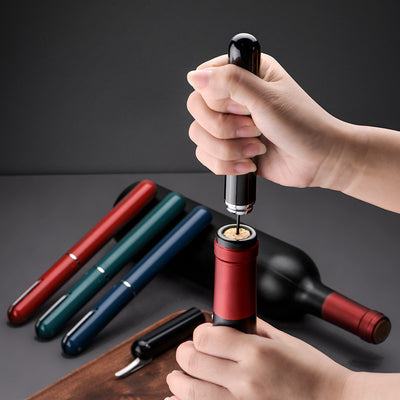
The Solution to Cork Breakage
Pen-Shaped Air Pressure Wine Bottle Opener
No worm. No compression. No pulling force. A hollow needle and gentle air pressure push every cork out whole. Works on fresh corks, old corks, and everything in between. No batteries, no charging, always ready.
From €16,14 Shop NowWhat Changes When You Switch to Air Pressure
- Every cork exists intact regardless of its age, condition, or storage history
- No wrist rotation, grip strength, or pulling force is required at any stage
- The intact cork can be immediately reinserted to reseal any unfinished bottle
- Opening time is under ten seconds from needle insertion to cork free of the bottle
- No batteries or charging. The opener is always ready whenever you need it.
- Compact pen-shaped body stores in any kitchen drawer, bag, or travel case
- For anyone who hosts wine nights, the broken cork problem disappears completely
If you host guests regularly or open wine more than once a week, the air-pressure opener is the right tool for you. Read our guide to hosting a wine night in Belgium for the full picture on what to have ready before guests arrive. And if you or someone you regularly open wine with struggles with grip or hand strength, the guide to the best wine openers for people who struggle with corks explains why the air-pressure method is the most accessible opening tool available.
FAQ
Questions People Also Ask
Cork Breakage Is a Problem with a Permanent Solution
A cork breaks because of dry material, a bad angle, insufficient depth, or excessive force. Every one of those causes vanishes when you remove the worm entirely from the equation. An air pressure opener pushes the cork out from below without gripping it, compressing it, or pulling it. The cork comes out whole every time. That is the solution, not a better technique with a tool that was never designed for reliability.
Get Your Opener from €16,14