

Everything from how many bottles to buy and which wines to choose, to the right tools, serving temperatures, glassware, and food. A complete guide for hosting a wine night that runs smoothly from the first pour to the last.
A wine night at home in Belgium does not need to be complicated. It does not require a cellar, a sommelier, or an expensive collection. What it does require is a bit of planning, the right tools, and a clear understanding of the basics. Get those right and the evening takes care of itself.
Belgium has a strong wine culture that often gets overlooked in favor of the country's legendary beer. Wine per capita consumption in Belgium ranks among the highest in Europe, and Belgian supermarkets like Colruyt and Delhaize carry extensive selections from France, Italy, Spain, and increasingly from Belgian wineries themselves, with over 350 now operating across the country. Hosting a wine night here means you have excellent options at every price point within easy reach.
This guide covers every practical element of hosting, from how many bottles to buy to how to open them without breaking a cork. For a full look at the tools that make opening wine effortless, read our guide to air pressure wine openers and the smart way to open any bottle.
01
How Many Bottles to Buy
Getting the quantity right is the most practical planning decision you will make. Too few bottles mean an awkward pause mid-evening. Too much is not really a problem, since unfinished wine can be resealed and kept. The calculation depends on how many people you are hosting, how long the evening will run, and whether you are doing a proper tasting or simply serving wine with food and conversation.
Quick Bottle Guide by Group Size
| Guests | Casual Evening | Structured Tasting | Dinner with Wine |
|---|---|---|---|
| 4 guests | 3 to 4 bottles | 1 bottle per wine variety | 3 bottles |
| 6 guests | 4 to 5 bottles | 1 bottle per wine variety | 4 to 5 bottles |
| 8 guests | 6 to 8 bottles | 1 to 2 bottles per wine variety | 6 to 7 bottles |
| 12 guests | 8 to 10 bottles | 1 bottle per wine variety | 9 to 10 bottles |
For a structured tasting format in which guests receive a 60ml sample pour rather than a full glass, one 750ml bottle serves up to 12 people. This is a useful format if you want to compare multiple wines without everyone having to drink heavily. It also lets you serve more variety without the cost of multiple full bottles per style.
02
Which Wines to Choose for a Mixed Group
The biggest mistake a host makes when choosing wine is selecting only what they personally enjoy. A mixed group has a range of preferences. Some guests prefer lighter whites. Some drink only red. Some are not sure what they like. Your job is to cover the main bases without overcomplicating the selection.
Three wines are the practical sweet spot for a group of six to eight: one white, one red, and a rosé or a sparkling option to open with. This gives enough variety without overwhelming guests or requiring you to manage too many open bottles at once.
- Sauvignon Blanc for crisp, fruit-forward freshness
- Unoaked Chardonnay for body without the butter
- Pinot Grigio for a light, easy-drinking option
- Serve between 8 and 12 degrees Celsius
- Chill in the fridge at least two hours before serving
- Merlot or young Bordeaux for approachable softness
- Côtes du Rhône for flavor without aggression
- Pinot Noir for lighter red drinkers and food pairing
- Serve between 14 and 18 degrees Celsius
- Avoid anything with very heavy tannins for a first wine night
- Provence-style rosé is the most universally liked style
- Dry and pale, not sweet or heavy
- Works as an arrival drink before the evening begins
- Serve between 8 and 11 degrees Celsius
- Always more popular than hosts expect. Buy one extra.
- Cava or Prosecco for a festive arrival without Champagne prices
- Crémant d'Alsace is widely available in Belgium, and excellent
- One bottle covers 6 guests for a welcome glass
- Serve between 6 and 10 degrees Celsius
- Always open sparkling wine by hand, never with a corkscrew
03
Belgian Wines Worth Serving
Belgium now has over 350 wineries producing sparkling, white, rosé, and red wines, with more than 5.5 million bottles expected from the 2025 harvest. The country's climate suits cool-climate grape varieties particularly well, and quality has improved sharply over the past decade. Including at least one Belgian bottle in a wine night adds a local angle that most guests find genuinely interesting.
Belgian wine production is concentrated in three areas: the Hageland and Haspengouw regions in Flemish Brabant and Limburg, the Heuvelland area near the French border in West Flanders, and the Gaume region in the south close to Luxembourg. Chardonnay and Pinot Noir are the most planted varieties, along with Riesling, Auxerrois, and Solaris.
What to Look for in Belgian Wine
- Belgian sparkling wines made by the traditional method from Chardonnay and Pinot Noir often rival Crémant in quality at similar prices
- White wines from the Hageland PDO show genuine minerality and freshness that suit food pairing well
- Pinot Noir from Belgian producers is lighter-bodied and elegant rather than heavy, which suits a wine night format
- Look for bottles from producers such as Wijnkasteel Genoels-Elderen, Clos d'Opleeuw, and Domaine du Ry d'Argent for reliable quality
- Most Belgian wines are available through specialist wine shops, Biowijn. be, or directly from winery websites, with delivery across Belgium
04
Serving Temperature: The Most Common Hosting Mistake
Temperature is the single factor most hosts get wrong, and it has a bigger impact on how a wine tastes than almost anything else. A red wine served too warm loses freshness, and the alcohol becomes aggressive. A white wine served too cold loses all its aroma and tastes flat. Belgian summer room temperatures regularly exceed 22 degrees Celsius, which is too warm for virtually every type of wine.
| Wine Type | Ideal Serving Temp | Fridge Time Needed | Common Mistake |
|---|---|---|---|
| Sparkling and Champagne | 6 to 10°C | 3 to 4 hours | Served too warm, bubbles go flat quickly |
| Light and dry white | 8 to 10°C | 2 to 3 hours | Over-chilled, so the flavor and aroma disappear |
| Fuller white and rosé | 10 to 12°C | 1.5 to 2 hours | Served straight from the fridge at 4°C |
| Light red (Pinot Noir, Beaujolais) | 12 to 15°C | 20 to 30 minutes in the fridge | Served at room temperature, tastes flat |
| Full-bodied red (Bordeaux, Syrah) | 15 to 18°C | 15 to 20 minutes in the fridge | Served too warm, alcohol overpowers everything |
When the French describe serving red wine at room temperature, they are referring to European cellar temperature of 15 to 18 degrees Celsius, not a heated modern living room at 22 degrees or above. Put your reds in the fridge for 15 to 20 minutes before guests arrive if the room is warm. Serve whites and rosé in an ice bucket or return them to the fridge between pours if the evening is long.
05
Glassware: What You Actually Need
The shape of a wine glass genuinely affects how the wine tastes and smells. A narrow opening concentrates the aromatics. A wide bowl allows oxygen contact. A thin rim means the wine lands more gently on the palate. You do not need to own twelve different specialist glasses, but you do need to understand what the basic shapes are for and which ones to prioritize for a wine night.
The Practical Glassware Setup for a Home Wine Night
- A universal tulip-shaped glass with a medium-wide bowl and slightly tapered rim works for both red and white wine if you are limited on space or budget
- A wider Bordeaux-style glass with a large bowl is best for full-bodied reds. The wider surface area allows tannins to soften and aromatics to open.
- A narrower glass with a slightly smaller bowl suits white wines and preserves their cooler temperature longer
- A Champagne flute or tulip glass for sparkling wine concentrates the bubbles and keeps the wine colder for longer than a wide glass
- Provide two glasses per guest minimum. One for white, one for red. This removes the need to rinse between wines and allows guests to compare.
- Hold by the stem, not the bowl. Body heat warms the wine, and fingerprints make it hard to see the color clearly.
06
Food Pairings That Work for Any Wine Night
Food at a wine night has one primary job: to give guests something to eat between pours so that no one is drinking on an empty stomach. The food choices should not overpower the wine; they should complement the range of wines you are serving rather than be designed specifically around a single bottle.
A well-assembled cheese and charcuterie board is the most practical and universally liked option. It requires no cooking, can be prepared in advance, stays at room temperature without deteriorating, and pairs with every type of wine, from sparkling to full-bodied red.
Building a Cheese and Charcuterie Board for Belgium
- Include one soft cheese, such as Brie de Meaux or a Belgian Herve, for richness alongside white wine
- Add a semi-hard cheese like Gouda, Gruyère, or Emmental that bridges red and white pairings
- Include a firmer aged cheese like Comté or an aged Belgian Aged Nazareth that pairs well with red wine
- Avoid blue cheese early in the evening. Its intensity overwhelms lighter wines and dominates the palate before guests can taste anything subtler.
- Add thinly sliced cured meats: Belgian salami, jambon d'Ardenne, or a good prosciutto
- Include plain crackers or a sliced baguette from a Belgian bakery as a palate cleanser between wines
- Grapes, dried figs, walnuts, and a small pot of quince paste or mostarda round out the board and pair naturally with both red and white
Simple Warm Options That Work Alongside Wine
- Gougères (light cheese puffs) are a classic French-Belgian addition that pairs with sparkling wine and white Burgundy
- Bruschetta with tomato pairs well with lighter Italian-style reds and Sauvignon Blanc
- Charcuterie-wrapped melon or figs bridge white and rosé wines in the summer months
- Plain breadsticks alongside hummus or tapenade act as neutral palate cleansers between heavier pours
07
The Tools Every Host Needs
A wine night with six or more guests means opening several bottles across the evening. The wrong opening tool turns that into a repeated source of stress. The right tools mean you open each bottle in seconds without interrupting conversation, without breaking a cork, and without asking someone else to help because the bottle will not cooperate.
- An air pressure opener opens any corked bottle in under 10 seconds
- No wrist strain or pulling force when opening multiple bottles
- Cork exits intact for resealing at the end of the evening
- Works without batteries, so it is always ready
- See our full comparison of electric, air pressure, and waiter openers
- Removes the capsule cleanly with one squeeze and a twist
- Avoids the ragged foil edge that traditional corkscrews leave
- Takes two seconds per bottle
- Most air pressure openers include one built in
- Needed for any bottle not finished during the evening
- Cork from an air pressure opener goes straight back in, intact
- A rubber or silicone stopper seals any bottle that the original cork cannot reseal
- Vacuum stoppers extend freshness up to 3 to 5 days after opening
- Keeps whites and rosé at the right temperature across the whole evening
- Fill with ice and cold water in equal proportion, not ice alone
- A large bowl or pot works just as well if you do not own a dedicated bucket
- Keep one on the table and one near the spare bottles in the kitchen
Optional But Useful
- A decanter for any full-bodied red that benefits from 30 to 45 minutes of aeration before serving
- Wine tasting cards and pens, if you want to run a blind tasting format
- Water glasses and a jug on the table. Hydration between wines slows consumption and keeps the evening enjoyable longer.
- Spare napkins for wiping bottle necks between pours to avoid drips on tablecloths
08
Opening Multiple Bottles Without the Stress
When you are hosting, you will open the first bottle before guests arrive, then open several more throughout the evening, often mid-conversation, while someone is asking you a question, or while balancing a plate. This is not the moment to struggle with a waiter's corkscrew for thirty seconds while the table watches.
An air pressure wine opener eliminates that moment entirely. The process takes under ten seconds and can be done one-handed once the foil is removed. The cork exists fully intact, which means it can go straight back into the bottle later in the evening if the bottle is not finished. There is no cork debris, no pulling effort, and no risk of sending the cork into the bottle at the wrong moment.
- Remove the foil capsule with a foil cutter. Keep one on the table within reach throughout the evening, so this step takes two seconds, not ten.
- Hold the bottle steady on the table with one hand resting lightly on the body, not the neck.
- Position the air-pressure opener vertically above the center of the cork. The needle needs to go straight through the middle.
- Apply steady downward pressure until you feel the needle tip pass through the bottom of the cork into the bottle space below.
- Pump the handle 4 to 7 times with a gentle up-and-down arm motion. You will see the cork begin to rise after three or four pumps.
- Continue until the cork pops free. Slide it off the needle using the ejection sleeve. Place the intact cork beside the bottle in case you need it later.
09
What Order to Serve the Wines
The order in which you serve wines determines how well each one shows. A heavy red served first overwhelms the palate and makes everything that follows taste thin by comparison. Start light and build in intensity across the evening. This is the same principle used in restaurant service and in every professional wine tasting format.
- Start with sparkling or a light dry white as a welcome drink while guests arrive
- Move to a fuller white or a dry rosé once everyone is seated and the food is on the table
- Introduce lighter red wines such as Pinot Noir or Beaujolais alongside cheese and charcuterie
- Serve fuller-bodied reds such as Bordeaux, Côtes du Rhône, or Syrah later in the evening when palates are more open to structure
- Finish with a dessert wine or a late-harvest style if the group enjoys sweetness, served in small quantities after the main food
- Dry wines before sweet, lighter before fuller, younger before older, where possible
10
What to Do with Unfinished Bottles
It is common to end a wine night with one or two bottles left. How you handle those bottles determines whether the remaining wine is still enjoyable the next day. An unprotected open bottle left on the counter overnight will have lost most of its character by morning due to oxidation.
Resealing Options from Best to Adequate
- The original cork from an air-pressure opener remains intact and fits straight back into the bottle neck without any damage or distortion. This is the cleanest and most practical option.
- A rubber or silicone wine stopper from any kitchen store creates an airtight seal on any bottle; the original cork cannot reseal cleanly.
- A vacuum wine pump removes air from the bottle before sealing. These extend white wine freshness to three to five days and red wine to two to three days when stored correctly.
- Moving wine from a large bottle into a smaller bottle or decanter with a tight lid reduces the amount of air in contact with the wine.
- Store resealed whites and rosé in the fridge. Store resealed reds in a cool, dark place, ideally at or below 18 degrees Celsius.
For more details on how an intact cork changes what you can do at the end of the evening, read our guide on wine openers that leave the cork intact.
11
Complete Hosting Checklist
Use this list to ensure nothing is missed in the hours and days before your guests arrive. Everything on it is practical and relevant, regardless of how formal or casual the evening is.
- Confirm your guest count and calculate bottle quantities
- Choose your wine selection: one white, one red, and one rosé or sparkling, minimum
- Buy wine and check that you have a good wine opener, foil cutter, and wine stoppers
- Confirm you have at least two glasses per guest and that they are clean and stored without strong odors nearby
- Put sparkling wine and whites in the fridge two to three hours before serving time
- Put light reds in the fridge for 20 to 30 minutes before serving if the room temperature is above 20 degrees Celsius
- Take cheese out of the fridge at least one hour before guests arrive
- Assemble the cheese and charcuterie board and cover with cling film until needed
- Fill an ice bucket with ice and cold water for white wine and rosé
- Set out glasses, water glasses, a water jug, napkins, and the wine tools on the table
- Open the first bottle before the doorbell rings so you are pouring, not struggling, when guests walk in
- Serve sparkling or light white as the welcome drink
- Return whites and rosé to the ice bucket or fridge between pours
- Introduce red wine after the food is on the table and guests have had a glass of white wine
- Keep track of which bottles need resealing at the end of the evening
The Right Tool Makes Hosting Easier
One Opener. Every Bottle. No Stress.
The most overlooked detail in wine night planning is the opener itself. A waiter corkscrew demands attention and technique every single time. An electric opener needs to be charged and takes twice as long. An air-pressure opener opens any cork-sealed bottle in under ten seconds with a few gentle pumps, leaving the cork intact so you can reseal anything that is not finished.
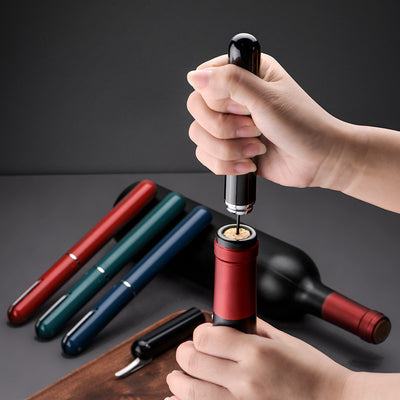
The Pen-Shaped Air Pressure Wine Bottle Opener from Novaireluxe ships directly to Belgium and is the tool that removes the one friction point that trips up even experienced hosts.
Essential Hosting Tool
Pen-Shaped Air Pressure Wine Bottle Opener
Opens any cork-sealed wine bottle in under ten seconds. No wrist strain, no broken corks, no batteries. Cork exits intact for easy resealing. Compact enough to keep on the table all evening. Available in four colours.
From €16,14 Shop NowWhy It Suits a Hosting Situation Specifically
- Opens each bottle in under ten seconds, so the conversation is never interrupted for long
- No grip strength or wrist rotation required across multiple openings in one evening
- Cork exits intact every time and can be immediately reinserted to reseal unfinished bottles
- No batteries or charging. Always ready when you need it.
- Compact pen-shaped body stays on the table without dominating the space
- Available in red, black, blue, and green. Matches any table setting.
FAQ
Questions People Also Ask
A Great Wine Night Starts with Good Planning
Get the quantities right, choose wines that suit a mixed group, serve at the correct temperature, and have the right tools on the table. Everything else follows naturally. The detail that most hosts overlook is the opener itself. One that works reliably, every bottle, without effort, without broken corks, and without interrupting the evening, is worth having.
Get Your Opener from €16,14