

An air pressure needle opener is excellent for natural cork, but not every bottle is sealed the same way. This guide explains exactly which closures it works on, which to avoid, and why one type of bottle should never be opened with a needle under any circumstances.
An air-pressure needle wine opener is one of the most reliable tools for opening wine without breaking the cork. But "wine bottle" does not refer to a single type of seal. Closures vary considerably, from natural cork to synthetic plastic, screw caps, glass stoppers, and pressurized sparkling wine seals. Not every closure interacts with a needle opener the same way, and one in particular must never be opened with a needle opener for safety reasons.
This guide breaks down exactly which bottle types work well with a needle opener, which do not work at all, and which pose a genuine safety risk if the wrong tool is used. Understanding this before you buy or use a needle opener means you will never be caught off guard at the table.
01
How a Needle Wine Opener Actually Works
Before deciding which bottles a needle opener can handle, it helps to understand exactly what the tool requires to function. A needle wine opener uses a thin hollow needle that is pushed through the full length of a cork. Once the needle tip passes through into the space below the cork, a pump sends air through the needle and into the bottle. As pressure builds in the gap between the cork's underside and the wine surface, it pushes the cork upward and out of the neck.
This mechanism depends on three specific conditions: the closure must be a cork-type material that the needle can pierce, the needle must pass cleanly through to create an airtight seal, and the bottle must not already contain significant internal pressure. When any of these conditions is not met, the tool either will not work, will not work safely, or will not apply to a closure it was never designed for in the first place.
02
The Wine Closure Landscape: What You Are Likely to Encounter
Wine closures have diversified considerably over the past two decades. Natural cork remains dominant globally, but several alternative closures now account for a meaningful share of bottles on shelves, particularly in New World wine regions and among value-focused producers.
- Natural cork accounts for roughly 70 to 72 percent of wine closures worldwide, rising to nearly 90 percent among premium wines, with over 13 billion natural cork stoppers produced annually
- Screw caps dominate in countries such as New Zealand, where they account for around 90 percent of all wine closures, and are widely used in Australia and Austria
- Synthetic and plastic corks are common on mid-range and value wines, particularly those intended to be consumed within a few years of bottling
- Glass stoppers such as Vinolok remain a smaller but growing premium category, particularly in Europe
- Sparkling wine and Champagne use a distinct mushroom-shaped cork under a wire cage, sealing a bottle that already contains significant internal pressure
Knowing which category a bottle falls into before reaching for any opener, needle-based or otherwise, avoids both frustration and, in the case of sparkling wine, genuine safety risk.
03
Natural Cork: The Closure It Is Built For
- Full compatibility with air pressure needle openers
- Works on fresh, aged, and dry corks alike
- Needle passes cleanly through wood-grain cork material
- This is the closure the tool was specifically designed for
- Generally compatible, works similarly to natural cork
- Made from genuine cork material, just compressed rather than whole
- Slightly less elastic than whole natural cork, but the needle passes through cleanly
- Common in mid-range wines intended for earlier consumption
Natural cork is the closure that a needle wine opener handles most reliably and is the reason this style of opener exists in the first place. The porous, fibrous structure of natural cork, composed primarily of suberin-rich cells, allows a thin needle to pass cleanly without tearing the surrounding material. This is true whether the cork is fresh and elastic or older and somewhat drier, which is precisely the situation where a needle opener has a genuine advantage over a worm-based corkscrew. A dry, brittle natural cork that would likely crack under a corkscrew worm's compression and pulling force is unaffected by a needle passing straight through it.
04
Synthetic and Plastic Corks: It Depends
- Often pierceable by a needle opener, depending on the model
- Softer material than petroleum-based synthetic corks
- Results vary by opener model and needle sharpness
- Test compatibility before relying on it for these bottles
- Frequently too dense and rigid for a thin needle to pierce
- Known among wine drinkers as the hardest closure to remove with any tool
- A standard corkscrew is usually more reliable for this closure
- Risk of bending or damaging the needle on harder synthetic material
Synthetic corks are made primarily from polyethylene, a malleable plastic compound engineered to mimic the look and feel of natural cork. Wine professionals frequently note that synthetic corks, particularly petroleum-based versions, are the hardest wine closure to open and reseal, with some described as virtually impossible to put back into the bottle once removed.
This density variation is exactly why compatibility with a needle opener is inconsistent. Plant-based synthetic corks made from bio-polyethylene tend to be noticeably softer and more pierceable than standard petroleum-based versions. Because synthetic cork hardness varies significantly by manufacturer and product line, the safest approach is to check the specific closure before assuming a needle opener will work, or to default to a standard corkscrew for any bottle with an obviously synthetic, uniform-looking closure.
05
Screw Caps: Not Applicable
- No cork present. The mechanism simply does not apply.
- Opens entirely by hand with a twist motion
- No tool of any kind is needed
- Often known by the brand name Stelvin
A screw cap is not a variation on a cork. It is a fundamentally different closure system: a threaded aluminum cap that screws directly onto matching threads on the bottle neck. There is no cork material present at all, which means the entire premise of a needle opener, piercing a cork and pushing it out with air pressure, does not apply. Trying to use a needle opener on a screw cap bottle accomplishes nothing because there is no cork to pierce.
Screw cap bottles are intentionally designed for convenience. They open with a simple hand twist, require no tool, and reseal cleanly for storing an unfinished bottle. Screw caps offer a tighter oxygen seal than natural cork, which makes them especially popular for wines intended to be consumed relatively young, such as many Sauvignon Blanc and other aromatic white wine styles.
06
Glass Stoppers and Vinolok: Not Compatible
- Solid glass closure, no cork material present
- Removed by hand with a gentle pull, no tool needed
- Includes a food-safe sealing ring for an airtight fit
- Reusable and fully recyclable by design
- Metal cap similar to a beer bottle closure
- Requires a standard bottle opener, not a corkscrew or needle
- No cork present at all
Glass stopper closures, sold under names such as Vinolok and Vino-Seal, use a solid glass plug fitted with a food-safe EVA sealing ring rather than cork. These closures are designed to be removed and reinserted by hand with a simple pull-and-push motion, offering a clean, reusable, and fully recyclable alternative to cork. A needle opener has no role here at all, since there is no porous material for a needle to pass through and no air gap below a cork to pressurize in the way the mechanism requires.
Crown caps, the same closure style used on most beer bottles, occasionally appear on casual or value sparkling wines and require a standard bottle opener rather than any cork-removal tool.
07
Sparkling Wine and Champagne: Never Use a Needle Opener
Sparkling wine uses a distinctive mushroom-shaped cork, made from thick cork bark of at least 31mm, compressed into the bottle and secured by a wire cage called a muselet. This combination is specifically engineered to contain the carbonation pressure generated during the wine's secondary fermentation, which can reach roughly 6 atmospheres in a bottle of Champagne, comparable to the pressure inside a bus or truck tire.
This is a fundamentally different situation from a still wine bottle. A still wine bottle has no internal pressure of its own. The air pressure introduced by a needle opener is the only force acting on the cork, applied gradually and predictably through gentle pumping. A sparkling wine bottle already has significant pressure pushing against the cork from the moment it is bottled. Introducing additional pressure through a needle has no predictable outcome and risks a sudden, forceful, and dangerous release.
08
Why Sparkling Wine Is Genuinely Dangerous with the Wrong Tool
Sparkling wine corks already travel at significant velocity when removed correctly, which is precisely why proper technique matters even with the right approach. A Champagne cork released without control can travel at speeds exceeding 40 kilometers per hour and has caused documented serious eye injuries, including permanent vision loss, when mishandled. Adding artificial air pressure on top of the wine's existing carbonation pressure substantially compounds this risk and removes any predictability about how or when the cork releases.
The Correct Way to Open Sparkling Wine
- Keep the bottle pointed away from yourself, other people, and anything fragile at all times during the entire process.
- Remove the foil capsule completely to expose the wire cage.
- Place a thumb firmly over the top of the cork before loosening the wire cage. The cork can begin to push out as soon as the cage tension is released.
- Untwist the wire cage loops, typically six full twists, while keeping constant pressure on the cork with your other hand.
- Grip the cork firmly with one hand and the base of the bottle with the other. Tilt the bottle to a 45-degree angle.
- Slowly twist the base of the bottle, not the cork, while holding the cork steady. This is the reverse of how many people instinctively try to open these bottles.
- Continue slowly until you feel the cork begin to ease free. Maintain steady backward pressure on the cork with your hand to control the release.
- Aim for a quiet, controlled hiss as the cork separates from the bottle rather than a loud pop. A loud pop means pressure was released too quickly, wasting carbonation and increasing risk.
09
How to Identify the Closure Before You Open the Bottle
Most of the guesswork around closure compatibility disappears once you know what to look for. A quick visual check after removing the foil capsule tells you almost everything you need to know before reaching for any tool.
Visible wood grain, small irregular pores scattered across the surface, slightly rough and organic texture, and a color that ranges from pale tan to deep amber, depending on the cork's origin and treatment.
Deliberately uniform appearance, smooth and often slightly glossy or rubbery surface, no visible grain pattern, and a consistent color throughout with no natural variation. May feel noticeably denser when pressed with a thumbnail.
No cork visible at all. An aluminum cap with vertical ridges sits directly on the bottle neck, sometimes with a tamper-evident perforated band at the base that breaks when the cap is first twisted open.
A visible glass top, often decorative or coloured, sitting where a cork would normally be. No cork material is present, and the closure is clearly rigid glass rather than a compressible material.
Always identifiable by the wire cage (muselet) wrapped around the neck beneath the foil, and a wider mushroom-shaped cork top that sits above the bottle lip rather than flush with it. If you see a wire cage, stop and use only the hand-twist method.
10
Full Compatibility Table
| Closure Type | Needle Opener Compatible | Notes |
|---|---|---|
| Natural cork | Yes | Full compatibility, including fresh, aged, and dry corks |
| Agglomerated / technical cork | Yes | Genuine cork material behaves similarly to natural cork |
| Plant-based synthetic cork | Often | Softer than petroleum-based synthetics, results vary by model |
| Petroleum-based synthetic cork | Usually not | Too dense for most needles to pierce cleanly; use a corkscrew instead |
| Screw cap | Not applicable | No cork present. Opens entirely by hand with a twist. |
| Glass stopper (Vinolok) | Not applicable | No cork present. Removed by hand with a gentle pull. |
| Crown cap | Not applicable | Requires a standard bottle opener, not a corkscrew or needle |
| Sparkling wine / Champagne | Never. Safety risk. | Already pressurized. Must always be opened by hand using proper technique. |
11
What to Use Instead for Each Closure Type
Knowing what does not work is only half the picture. Here is the right approach for every closure type that a needle opener is not suited to.
- Petroleum-based synthetic cork: Use a standard waiter corkscrew or lever corkscrew. The firm, even resistance of synthetic cork actually suits a worm-based opener well once inserted, even though it can take more force to insert and extract than natural cork.
- Screw cap: No tools required. Hold the bottle body steady and twist the cap counterclockwise by hand.
- Glass stopper (Vinolok): No tool required. Grip the glass top firmly and pull straight upward, rocking gently if needed.
- Crown cap: Use a standard bottle opener, the same tool used for beer bottles, positioned under the cap edge.
- Sparkling wine: Always open by hand using the controlled hand-twist method described above. Never use a corkscrew, saber, or needle opener of any kind.
For natural and agglomerated cork, which together account for the large majority of wine bottles you are likely to encounter, the needle opener remains the fastest and gentlest option available, particularly for older or more fragile corks. For a complete explanation of how the mechanism works and why it is so effective on standard cork closures, read our guide to air pressure wine openers and the smart way to open any bottle.
The Pen-Shaped Air Pressure Wine Bottle Opener from Novaireluxe is built specifically for natural and agglomerated cork, the closures that make up the large majority of wine bottles you will ever open. It pierces cleanly, applies gentle pressure, and removes the cork fully intact in under ten seconds, with no wrist strain and no broken corks.
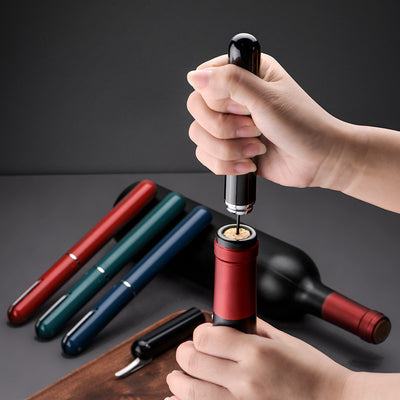
Built for Natural Cork
Pen-Shaped Air Pressure Wine Bottle Opener
Opens any natural or agglomerated cork wine bottle in under ten seconds with a few gentle pumps. No wrist strain, no broken corks, no batteries. Always check your closure type before use, and never use on sparkling wine.
From €16,14 Shop NowIf you regularly host or open multiple bottles in one evening, our comparison of electric vs air pressure vs waiter openers covers which tool suits different situations, and our guide to hosting a wine night covers everything else you need for the evening to run smoothly.
FAQ
Questions People Also Ask
Know Your Closure Before You Reach for the Needle
A needle wine opener excels on the closure most bottles actually use: natural and agglomerated cork. It is not designed for screw caps or glass stoppers, and synthetic cork compatibility depends on the specific material. The one rule that matters most: never use a needle, or any cork-piercing tool, on a sparkling wine bottle. Know what you are opening, and the right tool makes every still wine bottle effortless.
Get Your Opener from €16,14