

Three very different tools. Three very different experiences. This comparison covers every factor that matters so you can choose the right wine opener for how you actually drink wine.
Pick up any wine tool guide, and you will find strong opinions about corkscrews. Sommeliers swear by the waiter corkscrew. Weekend hosts reach for their electric opener. And a growing number of home drinkers have switched to the air pressure needle opener after years of broken corks and wrist strain.
The honest answer is that no single opener wins in every situation. The right choice depends on how often you open wine, how much effort you want to invest, whether you care about keeping the cork intact, and what your hands can actually handle comfortably. This guide walks through each opener type in full depth, then compares them side by side across every factor worth measuring.
For a broader look at the air pressure category specifically, including how the mechanism works and which bottle types it suits, read our complete guide on air pressure wine openers and the smart way to open any bottle.
01
What Makes a Wine Opener Actually Good
Most comparisons focus on one or two features. This one does not. A wine opener earns its place in a kitchen drawer by performing well across multiple dimensions at the same time. Getting fast results is valuable. Demanding almost no strength is valuable. Not destroying the cork matters more than most people admit. And reliability across dozens or hundreds of bottles over several years is what separates a tool from a gimmick.
Before comparing the three opener types, it helps to agree on what a good opener actually needs to do. The criteria below are the ones this comparison uses throughout.
- Speed from first contact to cork out of the bottle
- Physical effort required from the person using it
- Whether the cork exits completely intact
- Portability for travel, hosting at other venues, or outdoor use
- Upfront cost and total long-term cost including maintenance
- Reliability across different cork types including old, dry, or fragile corks
- Skill required before consistent results are possible
- Whether it works without power, charging, or consumables
02
Electric Wine Openers: Full Profile
An electric wine opener uses a battery-powered motor to drive a corkscrew worm into a cork and extract it automatically. You center the device over the top of the bottle, press a button, and the motor handles everything else. Most models complete the full extraction cycle in fifteen to twenty seconds and then eject the cork from the worm with a second button press or a reverse cycle.
Electric openers come in two main designs. Manual-start models have a button you press to begin the operation and a second press to stop and reverse. Automatic models activate the moment you apply downward pressure to the bottle neck and stop automatically once the cork is free. Both produce essentially the same result.
What Electric Openers Do Well
- Truly zero physical effort once the device is positioned
- Consistent results across natural and synthetic corks without any technique required
- Ideal for anyone with very severe hand limitations or mobility restrictions
- Opening multiple bottles quickly at a large gathering without fatigue
- No learning curve at all. Anyone who can press a button can use one immediately.
Where Electric Openers Fall Short
- Rechargeable lithium-ion batteries typically endure 300 to 500 charge cycles before capacity drops below 80 per cent, giving most models a realistic working life of two to four years
- Most models open between 30 and 80 bottles on a single charge. Leaving the unit on its charging dock continuously accelerates battery aging.
- The corkscrew worm compresses and partially shreds the cork during extraction. The extracted cork is not suitable for use as a bottle stopper.
- Bulkier and heavier than any other type of opener. Not practical to carry for travel or outdoor use.
- More expensive upfront than manual alternatives, and the battery cannot always be replaced when it degrades.
03
Air Pressure Wine Openers: Full Profile
An air-pressure wine opener operates on a completely different principle from any corkscrew-based tool. A thin hollow needle is pushed through the full length of the cork until the tip enters the bottle below. A pump handle is then worked up and down to send air through the needle into the bottle. As pressure builds below the cork, it pushes the cork upward and out of the bottle neck without any pulling force from above.
The result is that the cork exits fully intact, the bottle is opened in under ten seconds, and no grip strength, wrist rotation, or pulling force is required at any stage. The mechanism requires no batteries, no charging, and no consumables. Four to seven pumps is typically enough for a standard 750ml bottle, though older or drier corks may need a few more.
What Air Pressure Openers Do Well
- Fastest overall opening time once you know what to do, typically under ten seconds
- Cork exits completely undamaged and can be reinserted to seal an unfinished bottle
- No batteries, no charging dock, no power source of any kind. Always ready.
- Compact pen-shaped body stores in any kitchen drawer, bag, or travel case
- Suitable for anyone regardless of hand strength, grip, or wrist mobility
- Works reliably on fresh corks, older corks, agglomerated corks, and dry corks
Limitations to Know Before You Buy
- Must never be used on sparkling wine, Champagne, Prosecco, or Cava, as those bottles already contain significant internal pressure
- Does not work on bottles sealed with synthetic rubber stoppers, screw caps, or glass stoppers
- A very thick or unusually tight natural cork may require more than seven pumps. Stopping and repositioning the needle slightly resolves this in most cases.
- First-time users occasionally need a moment to orient the needle straight before pushing through
04
Waiter Corkscrews: Full Profile
The waiter corkscrew, also called a wine key or sommelier knife, is the most widely used wine opener in professional settings. It is a folding tool with three components: a serrated foil blade, a spiral metal worm, and a hinged fulcrum lever. To use it, the foil is cut, the worm is driven into the cork by rotating the handle, and the cork is then levered out using the fulcrum against the bottle lip.
The waiter corkscrew is compact, inexpensive, and long-lasting. A quality stainless steel model with a double-hinged lever will outlast most electric alternatives by many years. Wine critic Jeb Dunnuck has noted opening between 1,000 and 2,000 bottles a year at home with a single-hinged waiter corkscrew. That context matters. Professional fluency with this tool takes repetition that most home users never accumulate.
What Waiter Corkscrews Do Well
- Folds completely flat and fits in a shirt pocket or wallet
- Good stainless steel models last for a decade or more with no maintenance
- Cheapest entry point of any opener type. Quality models start under €10.
- The foil blade and bottle opener built into most models add utility beyond just cork removal
- In experienced hands, one of the most efficient tools available
Why It Fails Most Home Users
- Requires the worm to enter the cork at a perfectly straight angle. Off-angle insertion causes cork breakage.
- The worm must be pushed deep enough into the cork. Insufficient depth causes the cork to break during extraction.
- Pulling force and wrist strength are both required throughout the extraction stage
- Single-hinged models are significantly harder to use than double-hinged versions
- Cork breakage rate is highest among all opener types when used by someone without an established technique
Sommelier Adrienne Cooper and wine critic Elise Terlato both describe the waiter's corkscrew as the opener that wins in their hands. The key phrase is in their hands. Both professionals have opened hundreds or thousands of bottles. The tool rewards experience. It does not forgive the lack of it.
05
Speed: How Fast Does Each One Open a Bottle
Speed comparisons between opener types often focus only on the mechanical extraction step. That misses part of the picture. Total time from picking up the tool to pouring the first glass is what actually matters in practice, and that includes foil removal, positioning, extraction, and removing the cork from the tool.
| Opener Type | Foil Removal | Positioning | Extraction | Cork Removal from Tool | Total (Approx) |
|---|---|---|---|---|---|
| Air Pressure | 3 sec (separate cutter) | 2 sec (needle to center) | 5 to 7 sec (pumping) | 1 sec (ejection sleeve) | Under 15 sec |
| Electric | 3 sec (built-in cutter) | 3 sec (center on neck) | 15 to 20 sec (motor cycle) | 3 sec (reverse cycle) | 25 to 30 sec |
| Waiter (Expert) | 4 sec (blade) | 2 sec | 8 to 12 sec | 2 sec (twist off) | Under 20 sec |
| Waiter (Beginner) | 6 sec | 4 sec (angling) | 20 to 40 sec | 3 sec | 35 to 55 sec |
The air-pressure opener consistently wins in total opening time for most users. The waiter corkscrew can match or beat it in expert hands, but those expert hands are not representative of most home drinkers. The electric opener is the slowest of the three due to its motor cycle duration, regardless of skill level.
06
Physical Effort: Which Demands the Least from Your Hands
This is where the three opener types diverge most sharply, and where the choice matters most for people with arthritis, reduced grip strength, wrist pain, or any condition that limits hand mobility.
| Action Required | Electric | Air Pressure | Waiter |
|---|---|---|---|
| Grip strength needed | Minimal | Minimal | High |
| Wrist rotation required | None | None | Yes, sustained |
| Pulling force required | None | None | High |
| Fine motor control needed | Low | Low to moderate | High |
| Suitable for arthritis | Yes | Yes | No |
| Works one-handed | Usually | Yes | No |
For anyone with hand, wrist, or grip limitations, both electric and air-pressure openers are suitable. Between the two, the air-pressure opener has one practical advantage: the pumping action is a broad arm movement that does not require a firm grip on the handle. The bottle sits still while you pump. Someone who cannot grip anything tightly can often still work the pump using the palm of their hand or the base of their wrist.
If you want to understand more about which openers suit specific physical situations, the guide on best wine openers for people who struggle with corks covers this in detail.
07
Cork Integrity: Does the Cork Come Out Whole
Whether the cork survives the opening process matters more than most people consider. A cork that exists intact can be used to reseal the bottle, which matters whenever a bottle is not finished in one sitting. A shredded or cracked cork leaves fragments that are difficult to strain from the wine and makes resealing impossible without a separate stopper.
Why Worm-Based Openers Always Damage the Cork
- Both electric and manual tools drill a spiral worm through the centre of the cork
- The worm compresses and distorts the cork material as it enters
- Pulling the worm back out tears the cork walls and leaves visible damage
- The extracted cork has a central bore hole and compressed sides that prevent a reliable reseal
- Older or drier corks are far more likely to break into fragments during worm extraction
Why Air Pressure Always Leaves the Cork Intact
- The hollow needle passes through the cork without removing any material
- Air pressure pushes from below, so no pulling force is ever applied to the cork
- The cork exits with only a small needle hole that compresses closed naturally
- The same cork can be immediately reinserted as a stopper for an unfinished bottle
- Works reliably on fresh, aged, and dry corks without breakage
08
Portability and Storage
Not every wine bottle gets opened at home. Picnics, restaurant tables, hotel rooms, friends' houses, and holiday accommodation all present moments where you may want your own opener rather than relying on whatever is available. The three opener types differ substantially in how practical they are to carry.
Portability Breakdown by Opener Type
- Waiter corkscrew folds completely flat and weighs under 50 grams. It fits in a shirt pocket, a handbag, or a jacket lining. This is its strongest single advantage.
- Air pressure pen-shaped models are roughly the size and weight of a thick marker pen. They fit easily in a pocket or bag and require no case or protection.
- Electric openers are the largest category by far. They require counter or shelf space, are too bulky for travel, and need their charging dock or a USB cable wherever they go.
For anyone who opens wine only at home and does not need to travel with an opener, portability may not factor into the decision at all. For everyone else, both the waiter corkscrew and the air pressure pen opener are genuinely pocketable in a way that no electric model can match.
09
Cost and Long-Term Value
Upfront price and total cost of ownership are not the same thing. A cheap waiter corkscrew may need replacing every few years. A quality one lasts a decade. An electric opener may cost more upfront but runs trouble-free for two to four years before battery degradation becomes a problem. An air pressure opener has no battery to degrade and no consumable parts to replace.
| Cost Factor | Electric | Air Pressure | Waiter |
|---|---|---|---|
| Typical entry price | €18 to €40 | €10 to €20 | €6 to €25 |
| Ongoing running costs | Battery replacement or unit replacement after 2 to 4 years | None | None |
| Expected working lifespan | 2 to 4 years (battery limited) | 5 years or more | 5 to 10 years for quality models |
| Repair or part replacement | Difficult. Sealed units rarely repairable. | Needle replaceable on some models | N/A. No moving parts to fail. |
| 5-year total cost (approx) | €50 to €80 (one or two units) | €10 to €20 (one purchase) | €6 to €25 (one purchase) |
On pure long-term value, the waiter corkscrew and air pressure opener are both significantly cheaper than electric over any period beyond three years. The electric opener's convenience justifies its cost for some users, but it is not an economical choice compared to either alternative.
10
Master Comparison Table
This table brings together every dimension covered in the sections above. It reflects real-world performance for the majority of users, not ideal conditions for expert practitioners.
| Category | Electric | Air Pressure | Waiter Corkscrew |
|---|---|---|---|
| Speed (total, typical user) | 25 to 30 sec | Under 15 sec | 15 to 55 sec (skill-dependent) |
| Physical effort | Minimal | Minimal | High |
| Skill required | None | Very low | Moderate to high |
| Cork left intact | No | Yes | Sometimes |
| Works without power | No | Yes | Yes |
| Portability | Low | High | Very High |
| 5-year cost (approx) | €50 to €80 | €10 to €20 | €6 to €25 |
| Suitable for arthritis | Yes | Yes | No |
| Reliability across cork types | High | High | Variable (skill-dependent) |
| Best for sparkling wine | No | No | No (wire cage, not a cork) |
11
Who Wins in Each Real-World Situation
No single opener wins across every use case. The right tool depends on who is using it, where, and what they want from the experience. These are the most common scenarios and which opener suits each one best.
Fast, no batteries, always ready, and leaves the cork intact for resealing. Ideal as the everyday household tool.
Air pressure wins on speed and no-charge reliability. Electric wins if the host wants to hand the opener to guests of any ability level.
No wrist rotation, no pulling force, and no tight grip required at any stage. Electric is the alternative for very severe limitations.
Both fit in a pocket. Air pressure requires no technique. Waiter requires practice but is even more compact.
In trained hands it is the fastest, most reliable, and most portable option. Professionals open dozens of bottles a night and technique is fully established.
Compact, attractive, requires no learning, and produces a satisfying cork-pop result the first time. Practical and memorable as a gift.
A single button press with the device resting on the bottle requires the absolute minimum physical input of any opener type.
Both cost under €20 for quality options and have no ongoing running costs. The air pressure opener does not require technique to use effectively from day one.
12
The Overall Verdict
For most people opening wine at home, the air pressure opener wins this comparison. It is faster than the electric opener, requires no skill unlike the waiter corkscrew, demands no grip strength, works without charging, leaves the cork intact, and costs less than either alternative over any period of several years.
The waiter corkscrew wins for professionals who have invested the time to develop consistent technique. It is the most portable option, the cheapest to buy well, and in expert hands the most efficient tool available. The problem is that most people opening wine at home are not opening 1,000 bottles a year. The technique rarely gets developed, and the result is broken corks and inconsistent results.
The electric opener wins for people who need absolute zero effort and for whom the bulk and charging requirement are not a concern. It is the right choice for anyone with severe hand limitations who cannot manage even gentle pumping, or for hosts who want to hand a tool to a guest and have it work without any instruction at all.
The Pen-Shaped Air Pressure Wine Bottle Opener from Novaireluxe captures everything that makes the air pressure category the practical winner for most people. It opens any cork-sealed wine bottle in around seven seconds with four to seven gentle pumps. It requires no batteries, no charging, and no technique to get right from the first use. The cork exits intact every time.
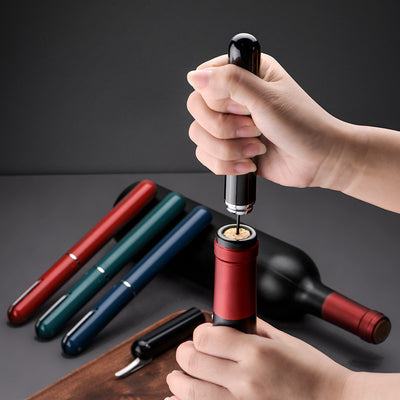
The Air Pressure Winner
Pen-Shaped Air Pressure Wine Bottle Opener
Opens any cork-sealed wine bottle in under ten seconds with a few gentle pumps. No twisting, no pulling, no broken corks. Compact enough for any pocket or drawer. Available in four colors.
From €16,14 Shop NowWhy It Wins the Comparison in Practice
- No wrist rotation or grip strength required at any stage
- Cork exits completely intact and can be reused as a bottle stopper
- No batteries, no charging dock, and no consumable parts
- Pen-shaped body fits in any kitchen drawer, bag, or travel case
- Works consistently on natural and composite corks regardless of age or condition
- Available in red, black, blue, and green with a retractable needle for safe storage
FAQ
Questions People Also Ask
The Right Opener Makes Every Bottle Easier
Electric, air pressure, and waiter corkscrews each do something well. For most people opening wine at home, the air pressure opener wins across the dimensions that matter most: speed, effort, cork integrity, portability, and total cost. It works perfectly from the first use, with no practice and no charging required.
Get Your Opener from €16,14