

Opening a bottle of wine should never be a struggle. If corks break, wrists ache, or the corkscrew keeps slipping, the problem is the tool. This guide shows you the easiest wine openers available and why some work so much better than others.
Not everyone finds opening a wine bottle easy. Traditional corkscrews require a good grip, steady wrist rotation, and confident pulling force. For many people, one or more of those things is genuinely difficult. Arthritis, reduced hand strength, wrist pain, or simply a lack of experience can all turn a simple task into a frustrating one.
The good news is that the problem is almost always the tool, not the person. There are wine openers designed specifically to remove corks with almost no physical effort. This guide covers all of them, explains who they suit best, and shows you how to choose the right one for your situation.
01
Why Corks Are Difficult for So Many People
A cork seals a wine bottle by fitting tightly inside the neck. The friction between the cork and glass is what keeps it in place. Removing it means overcoming that friction, and traditional corkscrews do this by gripping the cork with a spiral worm, then applying a steady upward pulling force.
That sounds simple. In practice, it requires several things to go right at the same time. The worm must enter the cork at a perfectly straight angle. It must be pushed deep enough to grip the full length of the cork. And then the cork must be pulled out smoothly without any sideways movement that could cause it to break. For many people, at least one of these steps is genuinely hard to get right.
The Physical Demands of a Traditional Corkscrew
- Firm grip to hold the corkscrew steady during insertion
- Wrist rotation to drive the spiral worm into the cork
- Sustained pulling force to extract the cork cleanly
- Steady hand control to keep the angle straight throughout
- Experience to judge when the worm is deep enough
02
People Who Benefit from an Easier Opener
Difficulty opening wine bottles is far more common than most people admit. It affects a wide range of people across different ages and situations. If any of the following describes you or someone you know, a different type of opener will make an immediate difference.
Situations Where a Standard Corkscrew Falls Short
- Arthritis or joint pain in the fingers, hands, or wrists
- Reduced grip strength due to age or medical conditions
- Wrist injuries or repetitive strain that make rotation painful
- Smaller hands that struggle to grip a standard corkscrew handle
- No prior experience with wine openers and no confidence in technique
- Regular broken corks that push pieces of cork into the bottle
- Hosts who need to open many bottles quickly without tiring
- Anyone who finds the whole process stressful or inconsistent
03
The Four Main Opener Types Compared
There are four main categories of wine openers available. Each one suits a different level of hand strength and a different set of priorities. This comparison covers all four across the factors that matter most when effort and reliability are the main concerns.
- No twisting or wrist rotation needed
- Only gentle pumping is required
- Cork comes out fully intact
- Works without batteries or charging
- Very compact and portable
- Fully automatic cork extraction
- Hold against the bottle and press
- Needs regular charging
- Shreds the cork during removal
- Larger and less portable
- The lever mechanism reduces the pulling force
- Still requires worm insertion
- Bulkier than other options
- More reliable than waiter style
- Can damage older dry corks
- Requires grip, rotation, and pulling
- High rate of cork breakage
- Demands skill and practice
- Most compact option available
- Worst choice for low hand strength
| Opener Type | Grip Needed | Wrist Rotation | Pulling Force | Cork Left Intact |
|---|---|---|---|---|
| Air Pressure | Minimal | None | None | Yes |
| Electric | Minimal | None | None | No |
| Lever | Moderate | None | Low | Sometimes |
| Waiter | High | Yes | High | Sometimes |
04
Air Pressure Openers: The Easiest Manual Option
An air pressure wine opener is the best manual option for anyone who struggles with a traditional corkscrew. It uses a completely different principle. Instead of twisting a worm into the cork and pulling it out from above, a thin hollow needle is pushed through the cork and air is pumped into the bottle from below. The air pressure builds up, pushing the cork out gently and completely.
No wrist rotation. No pulling force. No risk of the corkscrew slipping. Just a few gentle pumps and the cork slides out on its own. For anyone with arthritis, joint pain, weak hands, or a history of broken corks, this is the tool that changes everything.
Specific Advantages for Low Grip Strength
- The pumping motion uses the whole arm, not just the hand
- No tight grip on a small handle is required at any stage
- The bottle does all the work once air pressure builds
- Four to seven pumps are enough for most bottles
- The cork exits with a gentle pop and no sudden force
- Compact pen-shaped models need only one finger to pump
Pen-Shaped vs Pump-Handle Designs
- Pen-shaped models are slim and fit in a pocket or bag
- Pump-handle models have a larger grip and longer stroke
- Both work on the same air pressure principle
- Pen-shaped openers open a bottle in around seven seconds
- Pump-handle models may suit those who prefer a larger grip
05
Electric Openers: Fully Automatic Cork Removal
An electric wine opener is the right choice when someone needs truly zero physical effort. It uses a battery-powered motor to drive a corkscrew worm into the cork and automatically extract it. You hold the opener against the top of the bottle and press a button. The motor does everything else in about 10 to 15 seconds.
Where Electric Openers Work Best
- Severe arthritis or very limited hand and wrist function
- Opening many bottles at a gathering without fatigue
- Anyone who cannot apply even gentle pumping pressure
- Households where convenience is the highest priority
The Trade-Offs to Consider
- Needs regular charging and can run out at a bad moment
- Bulkier than any manual opener and harder to store neatly
- The corkscrew worm shreds the cork during extraction
- The extracted cork cannot be reused as a bottle stopper
- Generally more expensive than air pressure alternatives
- Cannot be used on sparkling wine any more than other openers
06
Lever Corkscrews: More Leverage, Less Effort
A lever corkscrew, sometimes called a rabbit corkscrew, uses a hinged lever mechanism that clamps onto the bottle neck and drives the worm into the cork with a single downward push. Pulling the lever back up extracts the cork. The mechanical advantage reduces the effort significantly compared to a waiter corkscrew, though it still requires the worm to be inserted and the cork to be pulled.
Suited to This Situation
- Moderate hand strength with no wrist pain or arthritis
- Anyone who wants more reliability than a waiter corkscrew
- Households that open wine regularly but not daily
- People who prefer a traditional cork removal method
Limitations to Be Aware Of
- Still uses a worm that can shred fragile or dry corks
- The clamp mechanism may not fit all bottle neck widths
- Larger and heavier than an air pressure or electric opener
- Not truly effortless for someone with significant hand pain
07
What to Avoid If You Struggle with Corks
Some wine openers are simply not suited to people who find corks difficult. Knowing which ones to avoid saves you from a repeated frustrating experience and protects both the cork and the wine inside the bottle.
The Waiter Corkscrew
- Requires the most skill and strength of any opener type
- The highest rate of cork breakage among all opener styles
- The folding knife attachment adds unnecessary complexity
- Not suitable for anyone with arthritis or reduced grip
- Compact size is its only real advantage for most users
Cheap No-Brand Corkscrews
- Worm threads are often poorly shaped and grip the cork badly
- Handles are uncomfortable and hard to grip under pressure
- No leverage mechanism makes extraction even harder
- Cork breakage rates are much higher with low-quality worms
08
How to Open a Bottle with No Effort at All
The air pressure method is the most effortless way to open a cork-sealed wine bottle. Here is exactly how to do it, step by step, so you get it right from the very first attempt.
- Remove the foil capsule from the top of the bottle. Most foil cutters require only a simple squeeze-and-twist to remove it cleanly. Some air pressure openers include a small foil cutter on the body.
- Place the bottle on a flat, stable surface. Keep one hand lightly resting on the body of the bottle to hold it steady. You do not need a tight grip.
- Hold the air pressure opener vertically above the center of the cork. The needle should be pointing straight down. Alignment is the only thing that matters at this stage.
- Apply gentle downward pressure to push the needle through the full length of the cork. You will feel a slight resistance as it enters, then a change in feel when the needle tip passes through into the bottle below.
- Begin pumping the handle slowly and steadily. Each pump sends a small amount of air into the bottle below the cork. There is no need to pump fast.
- After four to seven pumps, the cork will begin to rise. You will see it moving upward in the bottleneck. Continue pumping gently until it pops free.
- Slide the cork off the needle using the ejection mechanism. The cork is completely intact and can be reused as a stopper for any unfinished wine.
09
What to Do When a Cork Breaks
If you are reading this after a cork has already broken inside a bottle, here is what to do right now. And more importantly, here is how to make sure it never happens again.
Immediate Steps After a Cork Breaks
- Do not push the remaining piece of cork further into the bottle yet. Try to grip it with a two-pronged cork puller or a thin-worm corkscrew to extract it cleanly.
- If the remaining cork cannot be gripped from above, use a clean, thin object to gently push it all the way into the bottle. Push slowly so the cork goes in without splashing wine.
- Place a fine mesh strainer or clean tea strainer over a decanter, jug, or large glass. Pour the wine through it slowly. The strainer catches all cork pieces cleanly.
- Serve the wine from the decanter as normal. The wine itself is completely unaffected in taste or safety by brief cork contact.
Why the Air Pressure Method Prevents This Completely
- The needle has no worm to grip and compress the cork walls
- Air pressure pushes the cork out from below, not above
- There is no lateral force applied to the cork at any point
- Works reliably on fresh corks, older corks, and dry corks
- The cork exits fully intact every single time
10
The Right Tool for Effortless Opening
If you have been struggling with wine bottles, the solution is not to get better at using a traditional corkscrew. The solution is to switch to a tool that does not demand strength or skill in the first place. An air pressure opener is that tool. It works the same way every time, regardless of who is using it, and it never breaks a cork.
The Pen-Shaped Air Pressure Wine Bottle Opener from Novaireluxe is compact, lightweight, and designed for exactly this purpose. It opens any cork-sealed wine bottle in around seven seconds with a few gentle pumps. No batteries, no charging, no wrist strain, and no broken corks. It is available in four colors and comes in a compact size that fits in any kitchen drawer or bag.
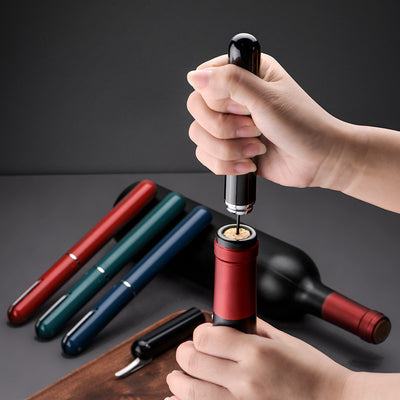
Recommended Tool
Pen-Shaped Air Pressure Wine Bottle Opener
Opens any cork-sealed wine bottle in seconds with a few gentle pumps. No twisting, no pulling, no broken corks. Compact, portable, and available in four colors.
From €16,14 Shop NowBuilt for People Who Need It Most
- No wrist rotation or grip strength required
- Retractable needle for safe storage between uses
- Lightweight ABS body is easy to hold and control
- Opens a bottle in approximately seven seconds
- Works on any natural or composite cork wine bottle
- No batteries or charging needed at any point
- Available in four colors including red, black, blue, and green
For the full picture on how air pressure openers work and how they compare against electric and waiter-style tools, read our complete guide on air pressure wine openers and the smart way to open any bottle.
FAQ
Questions People Also Ask
Opening Wine Should Never Be a Struggle
If corks break, wrists ache, or every bottle feels like a battle, the answer is a better tool. An air pressure wine opener removes any cork in seconds with no grip strength, no wrist rotation, and no pulling force. It is the simplest change you can make and one that works perfectly from the very first use.
Get Your Opener from €16,14